| Question | What applies | Planning use |
|---|---|---|
| Can I walk on this land? | Everyone has rights of responsible access to most land and inland water in Scotland. | Start from the assumption that you may walk, then check that how you walk is responsible. |
| Who has duties under the system? | The Scottish Outdoor Access Code sets out the responsibilities of both the public and land managers. | Read the Code before you push into unfamiliar ground, because it applies to you as much as to the landowner. |
| Can I take a dog? | Walking with a dog is permitted where access rights are exercisable, and the owner must act responsibly around livestock. | Plan routes with farmland in mind and keep the dog under close control near animals. |
| Can I camp? | Camping is permitted away from houses or roads and must be transient in nature. | Choose a remote, short-stay pitch and treat a roadside layby as the wrong place. |
Rules summarised from NatureScot and Highland Council’s Outdoor Highlands access guidance.
Scotland outdoor access rights give everyone the right to walk on most land and inland water, provided they act responsibly. The same framework covers a Fife path and a Highland glen, so this guide maps rules, wildlife and hill skills.
Read the scottish outdoor access code for the full set of responsibilities, then use the sections below to decide which topic to open next. Each section ends with a pointer to the deeper guide on that subject.
How Scotland’s access rights work
The legal basis
Scotland’s access rights are written into law rather than left to custom or goodwill. The Land Reform (Scotland) Act 2003 established a statutory framework of public access rights to most land and inland water. NatureScot, the public body that advises on land and access, describes the same legislation as giving everyone rights of responsible access to most land in Scotland.
For a walker, the practical result is a different starting point from many other countries. You do not need to look for a signed footpath before you set out. You can plan a day around the land itself, whether that is a hillside, a woodland edge or a stretch of shore, and you only need to ask whether your behaviour fits the framework.
That does not make planning unnecessary. It moves the planning question from “is this route allowed?” to “how do I use this ground well?” The answer depends on what is underfoot, who works the land and what time of year it is.
Responsible access, not a free-for-all
The phrase most people use is the right to roam, and the idea behind it is sound. The wording is worth getting right, though. A Guardian explainer on the subject makes the point that Scotland has a “right of responsible access” to the countryside rather than an unconditional licence to wander anywhere. Our guide to the right to roam scotland unpacks how the popular label and the legal wording fit together.
The responsibility part is not decoration. Scotways, the access charity, puts it bluntly: if you do not exercise your access rights responsibly you have no right of access. That gives a clear working rule. Responsible behaviour is the condition that keeps the right in place, so a walker who behaves badly cannot lean on the law to defend the behaviour.
The Code is the practical expression of that idea. Because it covers the duties of both walkers and land managers, it also protects you. If something about a landowner’s conduct seems wrong, the Code is the benchmark to hold it against.
Reading the word “most”
Both official summaries say “most” land, not all land. That small word matters when you plan. Treat the rights as a strong default that still has edges, and expect to meet ground where the position is less straightforward. When a situation feels unclear, go back to the Code rather than relying on a rule of thumb from a friend.
The same caution applies to anything you read online. Short summaries, including the table above, are useful for orientation but cannot cover every case on the ground. For anything that affects a route, the Code and NatureScot’s guidance are the references to check.
Dogs, farmland and horses
Walking with a dog
Dogs are welcome under the access framework, with a condition attached. Highland Council’s guidance says exercising and walking with a dog is permitted where access rights are exercisable, and it expects the owner to act responsibly around livestock. The condition is the owner’s behaviour, not the dog’s breed or size.
That makes a dog walk a question of route choice as much as dog control. A route across open hill or along a shoreline asks different things of an owner from a route that threads through working fields. Our guide to walking dogs scotland access rules covers how to apply this on a real walk.
Fields, cattle and sheep
Farmland is where the access system is most visibly shared. Animals are part of the working landscape, and the walker’s responsibility is to avoid causing them distress or disrupting the farm. If you are new to crossing farmland, start with a route where you can see the whole field before you enter it, so you can judge where animals are and choose your line calmly. The guide to walking through fields with cattle scotland goes through the practical decisions.
For a Fife walker this is often the most relevant topic of all. Much everyday walking close to home passes through or beside agricultural land, so the habits you build in a field edge carry directly into larger, more remote country.
Riding a horse
Horse riders have their own considerations, and local knowledge matters more for them than for walkers. The Highland guidance is plain on this: prior knowledge of the terrain to be ridden is always recommended. If you ride, treat a recce on foot or a conversation with local riders as part of the plan rather than an optional extra.
Camping and overnight stays
What counts as wild camping
The access framework includes camping, but in a particular form. Highland Council explains that camping is permitted with the intention that it is away from houses or roads and is transient in nature. Two ideas sit inside that sentence. The first is distance from buildings and roads. The second is that the stay is short rather than a settled base.
In practice that suits a walker who carries a light tent, pitches late, leaves early and leaves nothing behind. It does not suit a group that wants a fixed camp, or anyone who wants to pitch beside a road because it is convenient. Our guide to wild camping scotland rules covers the practical choices in more depth.
Vehicles are a separate matter
The same guidance draws a firm line around vehicles. Access rights do not extend to driving a vehicle off the public road or sleeping overnight in a vehicle. If you are planning a trip around a van or car, do not assume the tent rules cover you. The right is for people on foot with a tent, not for a vehicle parked on a verge.
Leaving the place as you found it
Camping is where the responsibility side of access becomes most visible, because a pitch can leave traces long after you have gone. The habits set out in leave no trace scotland are a sensible companion to the Code. They turn “act responsibly” into specific routines for waste, fires and pitch choice.
Hills, mountains and staying safe
The Highlands as a destination
The Scottish Highlands are where many walkers aim their ambitions, and the highest point is well known. Highland Council notes that Ben Nevis by Fort William is the highest mountain in the British Isles. Fame is a poor guide to suitability, though. A hill’s reputation tells you little about whether it matches your fitness, your kit or the season.
If you want a framework for choosing hills, the guide that answers what is a munro explains how Scotland classifies its higher hills. Use that as a way to understand the lists people talk about, not as a checklist you owe anyone.
Building up to bigger days
The sensible route into the hills is progressive. Fife’s lower hills, woodland paths and coastal walks are good places to learn pace, route-finding and clothing choices before a long mountain day. Skills built close to home transfer north, and mistakes made there are cheap.
The guide to hill walking safety scotland brings together the decisions that matter before you leave the car park. Treat it as the planning checklist for any day that takes you well away from roads.
Weather and winter
Weather is the variable that most changes a hill day, and it is the one you can research before you set out. A forecast written for the mountains is a better tool for a hill day than a general town forecast, which is why we have a dedicated guide to a mountain weather forecast scotland. Check it on the morning you go and again if your plans change.
Winter is a different proposition from summer rather than a colder version of it. If you are considering hills in the snow season, read the guide to winter hill walking scotland before you commit, and be honest about whether your experience matches the conditions you hope to meet.
Navigation and getting help
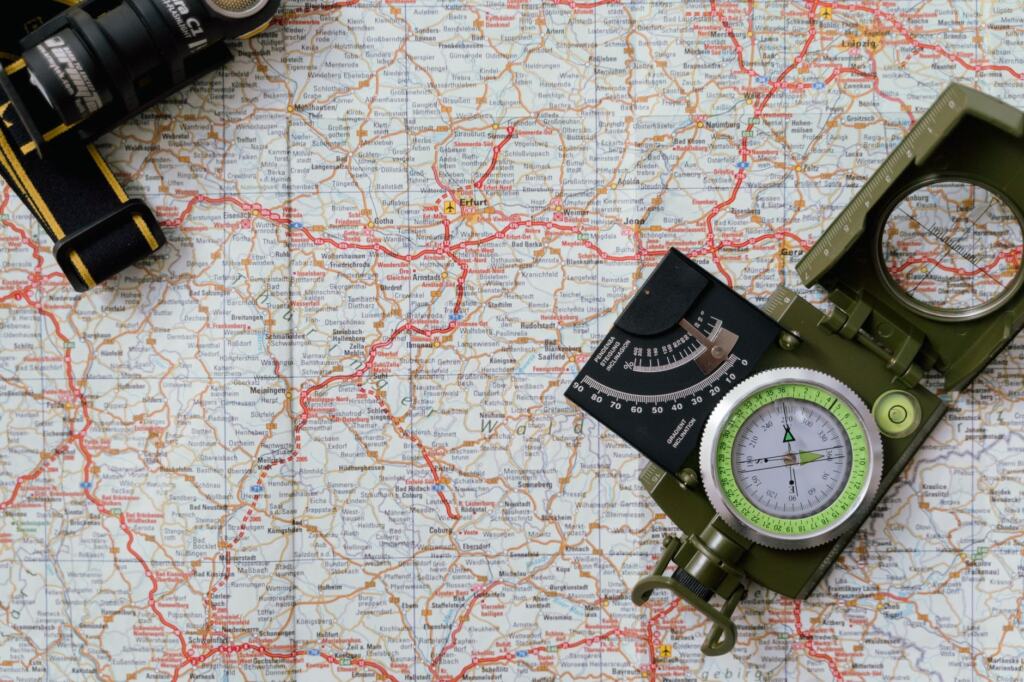
Phones and apps are useful, but a paper map and a compass do not run out of battery. If you plan to leave marked paths, learn the basics on easy ground first. The guide on how to navigate hill walking scotland builds those skills step by step.
Knowing what to do when things go wrong is part of the same preparation. The guide to how to call mountain rescue scotland explains what to do if you or someone in your group needs help. Read it before you need it, not in the middle of an emergency.
Wildlife you may meet on a walk
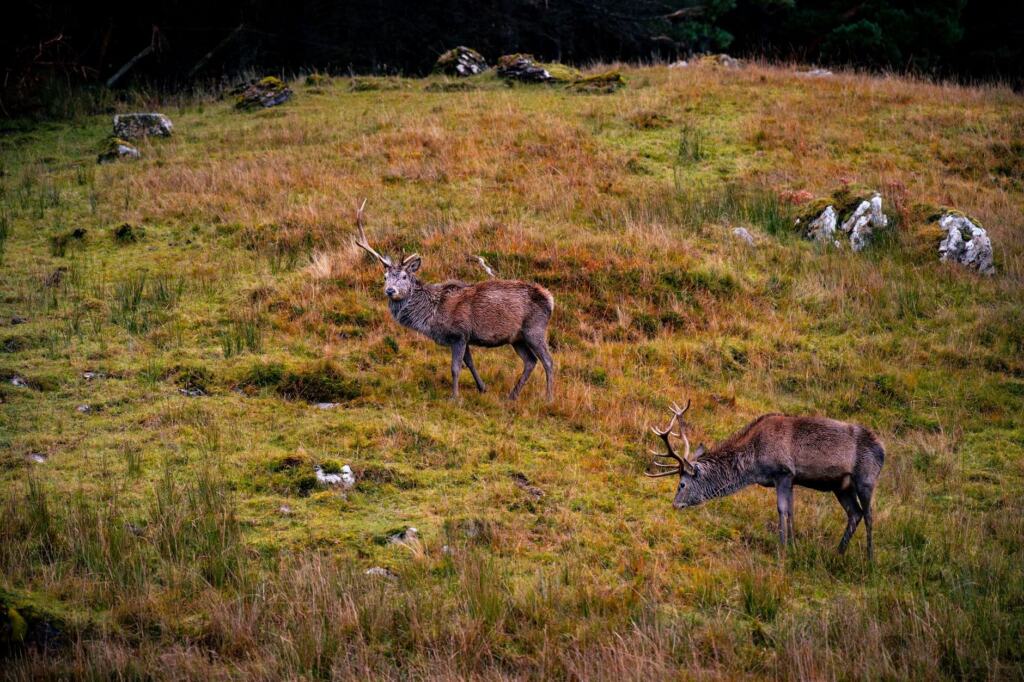
Deer on the hill
Large animals such as red deer are part of the Highland scene, and a stag on a skyline is one of the memorable moments of a hill day. Keep your distance and let the animal decide how close it is comfortable with you. Walking quietly and not chasing a better photograph are habits that cost you nothing.
Small animals, large importance
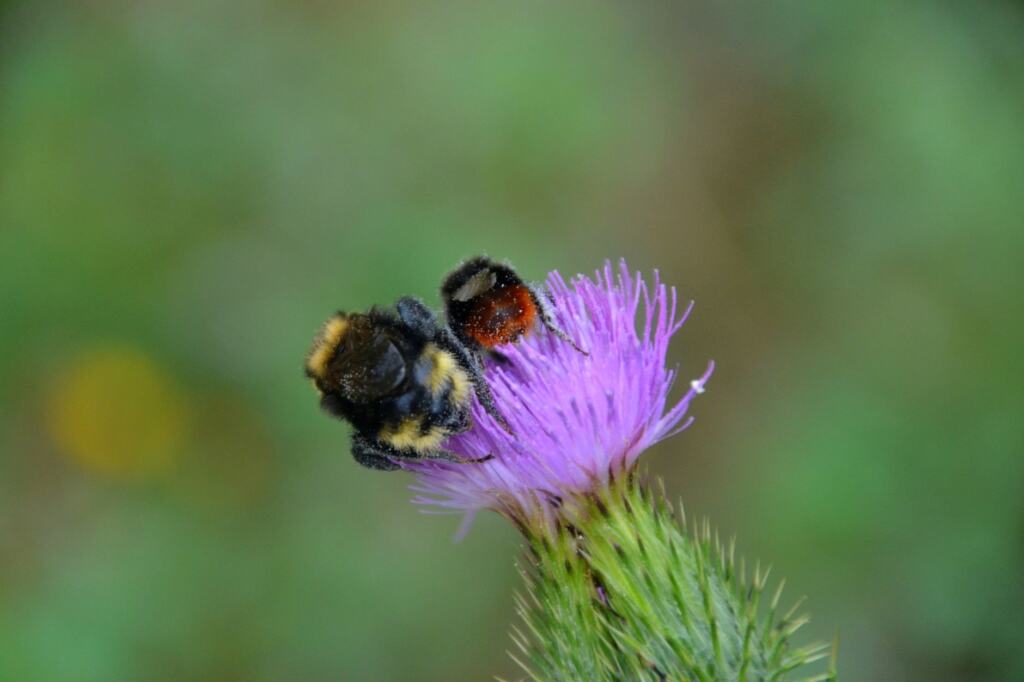
Not every wildlife encounter is dramatic. Bumblebees working a flower beside a path are as much a part of the Scottish outdoors as a deer on a ridge, and they are easier to enjoy because they let you slow down. Stopping for a few minutes at a flowery verge is a good way to notice what lives in the landscape you are crossing.
The wildcat and species recovery
The Scottish wildcat is the species most closely tied to conservation debate in the Highlands. NatureScot states that a new national strategy aims to restore wildcats to a level where they are thriving and expanding in Scotland, with 2045 as the target date for that goal. That is a long horizon, which tells you something about the scale of the task.
For a walker, the sensible response is to treat the wildcat as a conservation story rather than a sighting target. It is a reason to care about how land is managed, not a reason to go looking for an animal.
Ticks and other small hazards
Wildlife also brings minor health considerations. Ticks are the best known, and checking yourself after a walk through long grass or woodland is a habit worth forming wherever you walk in Scotland. Our guide to ticks scotland walking explains what to look for and what to do.
Rewilding and the woodland you walk through
Rewilding is a broad word, and walkers meet it in different forms: native woodland planted or regenerating on former open ground, species recovery programmes and changes to how large estates manage their land. The access framework applies across all of it, because the legislation applies to most land and inland water rather than to a defined list of walking areas.
That has a practical consequence. Land that is being restored is still land you can usually walk on responsibly, and the way you behave there matters more, not less. New planting, nesting sites and regenerating ground can all be easily damaged by careless boots, so keeping to established tracks where they exist is a fair rule of thumb on sites in transition.
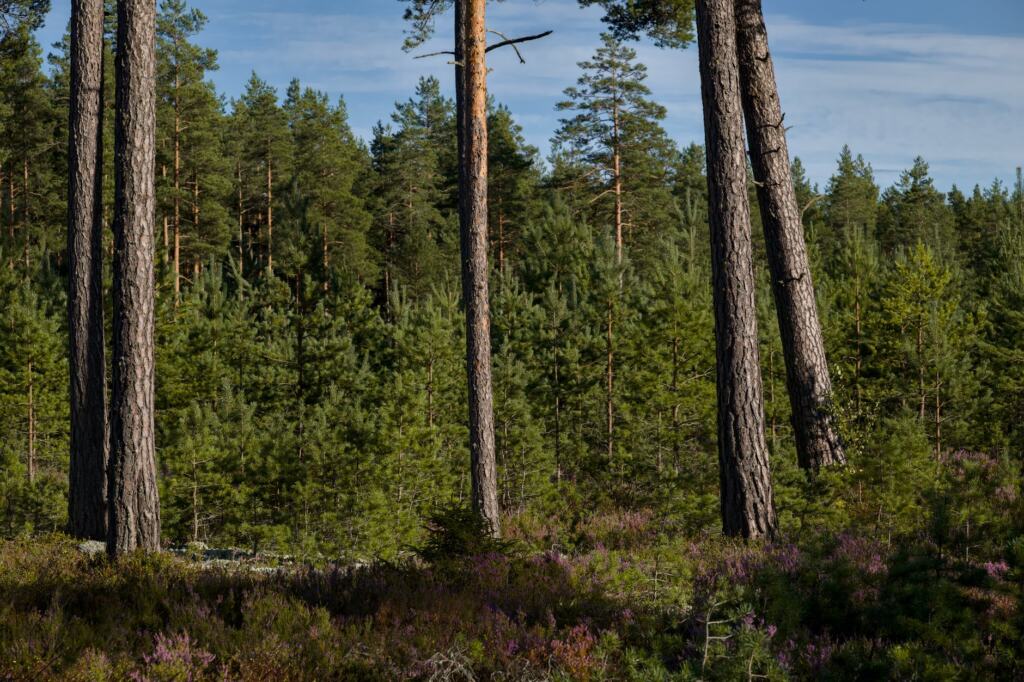
A Fife walker does not need to travel to the Highlands to engage with these ideas. Local woods, hedgerows and field margins are part of the same landscape conversation about habitat, and noticing how they change from season to season is a good way to learn what healthy ground looks like.
Coastal walking and walking from Fife
Using the coast
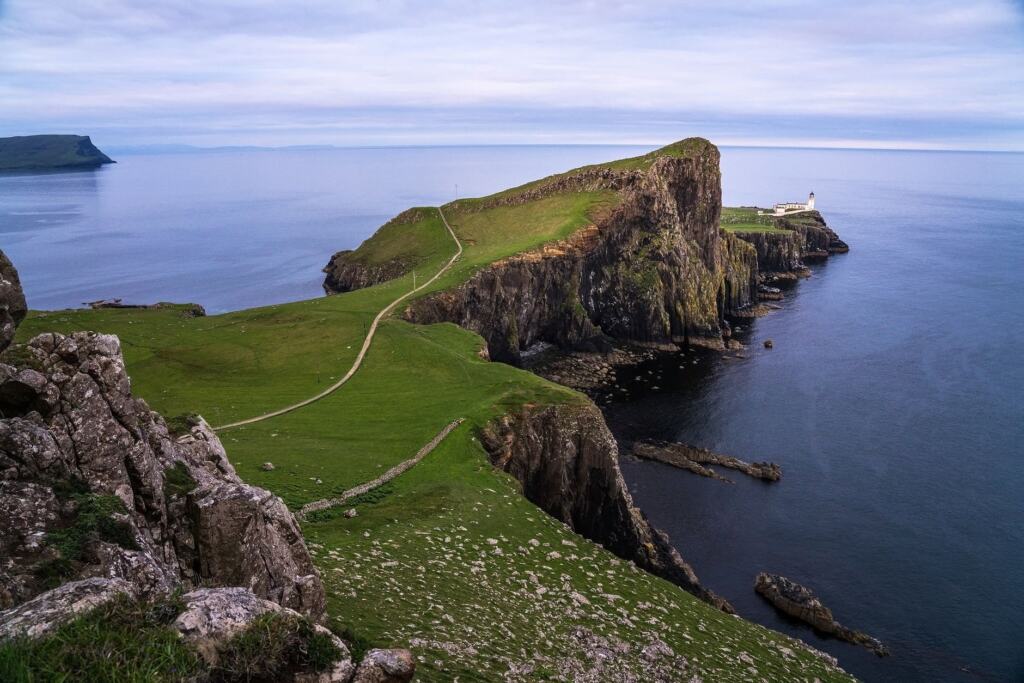
Coastline is often the easiest ground for a new walker to start with, and the access framework applies there as it does inland. A shore or cliff path gives a clear line to follow and a constant visual reference, which makes route-finding simpler than on open hill. It still deserves care, particularly where paths run close to edges, so choose your route and your timing with the weather in mind.
Scaling up from home
Once your local walks feel comfortable, Scotland offers several ways to extend your range. The guide to national parks in scotland helps you compare the larger protected landscapes as walking destinations. For longer, linear journeys, scotland’s great trails brings together the long-distance routes that can anchor a multi-day plan.
Choose between them according to what you want from the trip. A national park suits a base-camp approach with varied day walks. A long trail suits someone who wants a journey with a beginning and an end. Neither requires a different legal footing from your local walks, because the same access framework runs through all of them.
Where to start
Scotland’s outdoors is large, and the quickest way to feel overwhelmed is to try to learn everything at once. These decisions help you pick a starting point.
- If you are new to access rights: read the Scottish Outdoor Access Code guide first, then the explanation of the right to roam. Together they give you the principles that everything else builds on.
- If you walk with a dog or near livestock: go to the dog and farmland guides before your next field-edge walk. Your behaviour around animals is where responsibility is tested most often.
- If you want to camp: read the wild camping guide and the Leave No Trace guide as a pair, and decide whether you are camping on foot or travelling by vehicle, because the rules differ.
- If you want to climb hills: begin with hill walking safety and the mountain weather guide, then add navigation. Hold winter walking back until you have built experience in easier seasons.
- If you want to explore further afield: compare national parks and the great trails, and pick the format that matches the time you have.
Whatever you choose, the underlying principle stays the same. The right of access is generous because it assumes walkers will behave thoughtfully, and the more you understand about land, weather and wildlife, the easier that is to do well.
Frequently asked questions
When did Scotland’s statutory access rights begin?
Part 1 of the Land Reform (Scotland) Act 2003 came into operation on 9 February 2005, according to Scotways’ history of access rights.
Can a landowner close a route or put up a deterrent sign?
A restriction has to be a genuine land management decision, and the Code discourages signs that deter access other than for temporary periods. A sign alone does not necessarily end your right of access.
Who deals with local access problems?
NatureScot explains that the 2003 Act gives local authorities a key role in advising on and helping to resolve local access issues, with local access forums supporting that work and a National Access Forum advising nationally. The details are on NatureScot’s access page.
Do access rights cover cycling and horse riding as well as walking?
Yes. Legal commentary from McKinstry describes the right of access over most land as covering walking, cycling, horse riding and camping.